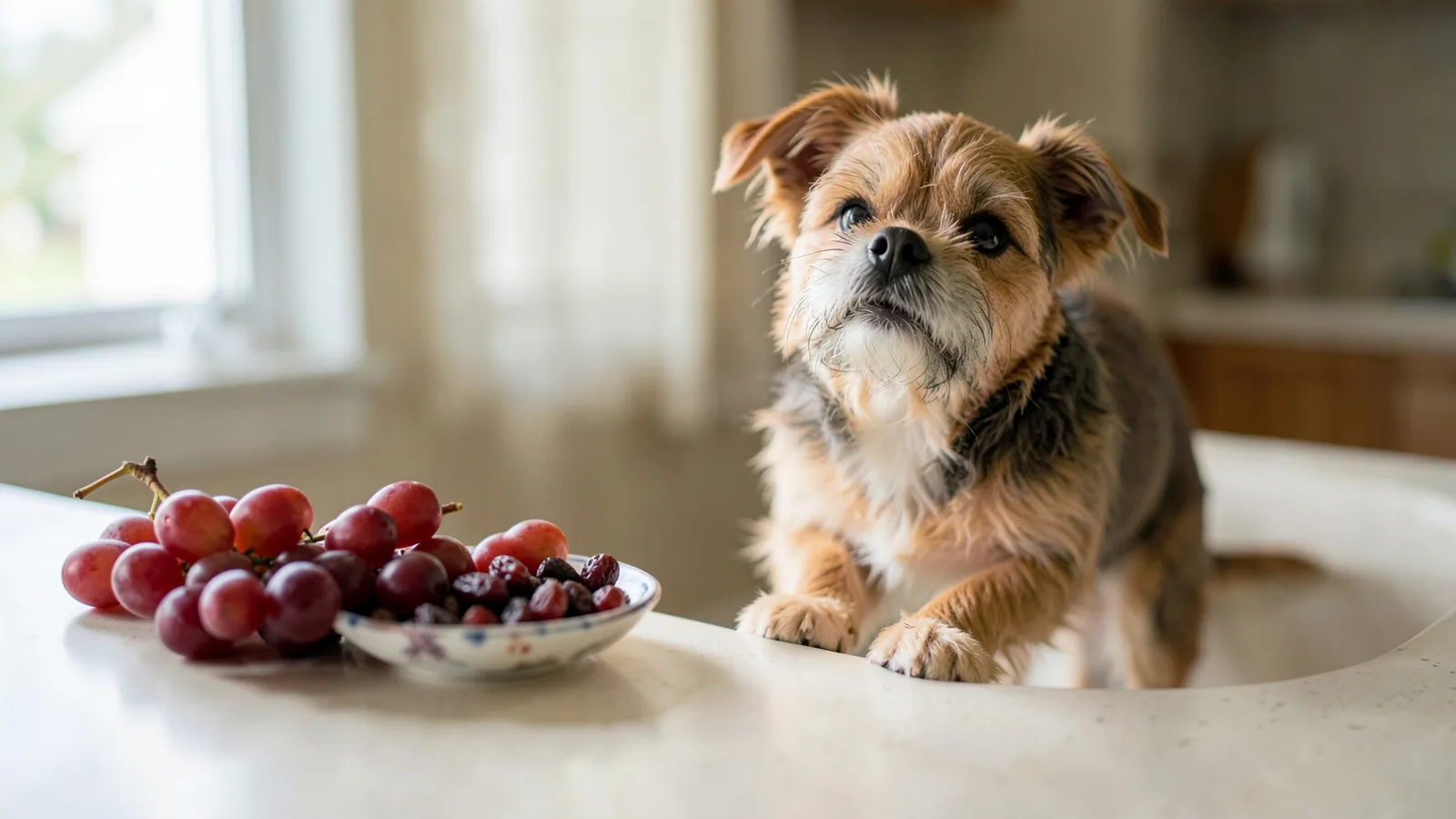
The short answer
No. Puppies shouldn't eat grapes, raisins, sultanas or currants. There's no established safe amount, and a tiny puppy has far less body weight to absorb the same fruit, so even one or two grapes can be a bigger dose. If your puppy has eaten any, call your vet or a poison line now, before signs appear. Treatment works best in the first hours.
Call a vet now if your dog has
- Your puppy has eaten any grape, raisin, sultana or currant: call now, don't wait for signs
- Vomiting or diarrhea within hours of eating them
- Unusual sleepiness, weakness or refusing food or milk replacer
- Drinking or peeing much more or much less than normal
- Belly pain, trembling or collapse
A single grape feels like nothing. For a 70 pound Labrador it might be. For a 5 pound Chihuahua puppy, it's a different story. Body weight is the whole reason puppies deserve their own warning.
Think of it like a glass of wine. One glass barely registers in a large adult, but the same glass hits a child's size much harder. A puppy is the small end of that comparison. This page covers how size changes the risk, why there's no safe amount, and what to do in the first few minutes. For the full background on the poison itself, see our guide on whether dogs can eat grapes.
Why puppies are a bigger worry
Grapes, raisins, sultanas and currants can cause sudden kidney injury in dogs. The Merck Veterinary Manual says tartaric acid, an organic acid found in high concentrations in these fruits, may pose a risk to the kidneys. The ASPCA describes tartaric acid as the speculated toxic component. VCA also lists it as a possible culprit, but calls the cause unconfirmed. So the best current explanation points to tartaric acid, though it isn't fully proven.
Size is where puppies differ. Poisons work on a dose per body weight. A small body means the same fruit makes up a bigger share of what's inside your puppy.
Small body, small buffer
A kidney works like a coffee filter. A normal amount of coffee passes through fine. Pour in too much and the filter clogs. A puppy's kidneys are smaller and have less spare capacity than an adult's. There's less room before things go wrong.
Dogs react very differently
VCA states there's no well-established toxic dose for these fruits, and some dogs have individual sensitivities. That's the part that makes grapes so unpredictable. One dog eats a handful and seems fine. Another gets seriously ill after a few. You can't tell which kind of dog you have, and a puppy has no history to go on.
Puppies find trouble fast
Puppies explore with their mouths. They grab dropped snacks, raid low bags and chew whatever a toddler leaves on the floor. A toy breed puppy can also be gone from your sight for only a minute. That's often all it takes.
Puppy weight and urgency
Here's the honest picture. The Merck Veterinary Manual says more than one grape or raisin per 4.5 kg (10 pounds) of body weight may contain enough tartaric acid to pose a risk to the kidneys. That's a rough guide to how seriously to treat an amount. It isn't a safe limit, and it doesn't prove that smaller amounts are harmless.
| Puppy weight | Example breeds at that size | What one grape means | What to do |
|---|---|---|---|
| Under 2 kg (4.5 lb) | Teacup Yorkie, young Chihuahua | Well past the Merck guide for risk | Call a vet or poison line now |
| 2 to 4.5 kg (4.5 to 10 lb) | Pomeranian, Maltese, young Pug | At or past the guide | Call a vet or poison line now |
| 4.5 to 9 kg (10 to 20 lb) | Young Beagle, Cavalier, French Bulldog | Within the guide for one or two, but not proven safe | Call a vet or poison line now |
| Over 9 kg (20 lb) | Growing Labrador, Golden Retriever, Boxer | Less of the guide used, still not proven safe | Call a vet or poison line now |
Notice the last column. It doesn't change. That's deliberate. Because no reliable safe dose exists, every row ends in the same advice.
Why there's no per kilogram number here
Many owners search for a toxic amount per kilogram. A reliable one hasn't been established. Grapes differ by variety and ripeness, and dogs differ in sensitivity. Any site that gives you a precise safe number is guessing. Use the weight guide above to judge how urgent things feel, not to decide whether to call.
What counts as a grape exposure
Puppies don't only eat whole grapes. Check for all of these:
- Red, green, seedless or organic grapes, including stalks with fruit still attached
- Raisins, sultanas and currants
- Fruit loaves, hot cross buns, scones and mince pies
- Cereal, granola bars and trail mix
- Chocolate-covered raisins, which add a second poison (see our chocolate poisoning guide)
VCA also points out that some jams and cereal pastes contain grape or raisin ingredients. If you aren't sure what your puppy ate, keep the packaging and phone a poison line.
What to do right now
Move quickly and stay calm. Here's the order that works best.
- Take away any remaining fruit. Check your puppy's mouth for pieces.
- Write down what you know. Roughly how many, what type, when, and your puppy's weight.
- Call your vet or a poison line immediately. In the US, the ASPCA Animal Poison Control Center is on (888) 426-4435. A fee may apply.
- Follow their instructions exactly. They may tell you to come in right away.
- Don't wait to see if signs appear.
Don't try to make your puppy vomit at home on your own. Salt is dangerous. Hydrogen peroxide is only for use on direct veterinary advice, because the dose and method matter a lot in a small body.
Why the first hours matter
VCA says dogs treated before symptoms appear generally recover well. Once kidney failure sets in and urine production stops, the prognosis is poor. The Merck Veterinary Manual says most dogs with anuric renal failure die or are euthanized. Early treatment is the single biggest thing you can do for your puppy.
Signs to watch for
Don't use signs as a reason to wait. They're a late warning. But if you're on your way to a vet, or if you only discover the ingestion later, here's what can appear.
The first day
The Merck Veterinary Manual says vomiting or diarrhea usually appear within 6 to 12 hours. VCA lists 12 to 24 hours. Your puppy may also seem sleepy, off food or tender in the belly. In a puppy, vomiting and diarrhea can also mean dehydration very quickly. If your puppy has been sick, our guide to dog vomiting explains what to track.
Days one to three
As the kidneys are affected, signs can include weakness, a lack of interest in play, bad breath, tremors and changes in peeing. A puppy may drink and pee a lot at first, then very little. Kidney changes develop within 24 to 72 hours, according to the Merck Veterinary Manual.
What the vet will do
If your puppy is seen soon after eating the fruit, the vet will usually try to empty the stomach with a veterinary medicine. Merck lists drugs such as apomorphine or ropinirole, and sometimes hydrogen peroxide under supervision. Treatment can also include activated charcoal.
For a significant ingestion, expect intravenous fluids. The Merck Veterinary Manual recommends aggressive fluid therapy for at least 48 hours. Blood tests are repeated to check how the kidneys are coping. VCA notes there's no specific lab test that confirms grape poisoning, so monitoring kidney values is the main tool.
Hospital care for a small puppy takes extra attention. Tiny dogs lose body heat and blood sugar quickly. Your vet will keep a close eye on both.
Keeping grapes away from your puppy
Prevention is easier than treatment. A few habits cover most of the risk.
- Keep fruit bowls and snack bags off low tables and chairs.
- Put cereal bars, trail mix and baked goods in closed cupboards.
- Tell children that grapes and raisins aren't safe to share or drop.
- Ask visitors and dog sitters not to hand out "healthy" snacks.
- Check floors under high chairs and sofas after meals.
- Close the bin lid and secure the compost.
If you'd like to give treats, choose puppy-safe options and keep them small. Plain apple slices with no core or seeds and a few blueberries are common choices. Check with your vet before adding new foods to a very young puppy's diet.
Grapes aren't the only kitchen hazard. Onions and garlic cause a different kind of trouble, covered in our guides on onions and garlic. Our poisoning and emergencies section lists the other household dangers worth knowing.
When to see a vet
With grapes, the answer is simple: contact a vet or poison line whenever your puppy has eaten any amount, or you suspect it might have.
Go straight in, or phone ahead and go, if:
- your puppy has eaten any grape, raisin, sultana or currant, even one
- you can't tell how much was eaten
- your puppy is under 4.5 kg (10 pounds), a toy breed, or very young
- your puppy vomits, has diarrhea, or seems unusually quiet
- your puppy is drinking or peeing much more or less than normal
- your puppy shows belly pain, trembling or collapse
Call before signs appear. Waiting for symptoms trades away the time when treatment works best. A phone call that turns out to be unnecessary costs you a few minutes. A missed ingestion can cost a puppy its kidneys.
Common questions
My puppy ate a grape. What should I do?
Call your vet or a poison line straight away, even if your puppy seems completely normal. Take away any remaining fruit, then work out roughly how many your puppy ate, when, and what your puppy weighs. Don't try to make your puppy vomit at home unless a vet tells you exactly how.
Is one grape enough to hurt a puppy?
It might not be, but nobody can promise that. VCA Animal Hospitals notes there's no well-established toxic dose and some dogs are individually sensitive. A puppy has far less body weight than an adult, so one grape is a larger share of the total. That's why vets treat a single grape in a small puppy as worth a phone call.
How long after eating grapes will a puppy show signs?
Vomiting and diarrhea often start within 6 to 12 hours, though VCA lists 12 to 24 hours. Signs of kidney trouble can follow at 24 to 72 hours. Many dogs look fine at first, so waiting for symptoms means losing the best window for treatment.
Are raisins more dangerous than grapes for puppies?
Weight for weight, raisins are the bigger worry. They're dried grapes, so the same fruit is squeezed into a much smaller piece. A few raisins from a cereal bar or a slice of fruit loaf can be a real dose for a toy breed puppy.
Sources
- Grape, Raisin, and Tamarind Toxicosis in Dogs, Merck Veterinary Manual
- Grape, Raisin, and Currant Poisoning in Dogs, VCA Animal Hospitals
- People Foods to Avoid Feeding Your Pets, ASPCA Animal Poison Control Center
This article is general information to help you decide what to do next. It is not a diagnosis and is not a substitute for examination by a veterinarian. If you are worried about your dog, call your vet.
Reviewed by Winzah, Editor, on . How we research and check articles.
Related articles
Can Dogs Eat Garlic?
Garlic is several times more toxic to dogs than onion. How much garlic is dangerous, why it isn’t a safe flea remedy, the signs of poisoning and what to do.
Can Dogs Eat Onions?
No. Raw, cooked and powdered onions damage dogs’ red blood cells. How much onion is toxic, the delayed signs to watch for, and what to do if your dog ate onion.
Can Dogs Eat Grapes or Raisins?
No: grapes, raisins, sultanas and currants can cause sudden kidney injury in dogs. What makes them toxic, the signs, and what to do if your dog ate one.