The short answer
You can't stop a puppy biting overnight, and you shouldn't try to. The goal is to teach bite inhibition, so your puppy learns to control how hard it bites. When teeth touch skin, yelp or go quiet, pause the game for 10 to 20 seconds, then offer a toy. Keep sessions calm, make sure your puppy gets enough sleep, and never hit or scruff a puppy, because that can make biting worse and create real aggression. If hard biting continues past 6 months, bring in a trainer.
Call a vet now if your dog has
- Growling, stiffening or freezing when you touch food, toys or a resting spot
- Lip curling, showing teeth or snapping at you without any play
- Biting that breaks skin and is getting harder rather than softer
- Biting that comes with fear, such as cowering, shaking or backing away first
- Any bite aimed at a child's face or a guest
- Hard biting that hasn't eased by about 6 months despite consistent training
If your hands look like you've lost a fight with a rosebush, you're not alone. Puppy biting is one of the most common complaints new owners have. It feels personal, but it isn't. Your puppy has about 28 sharp baby teeth and a brain that's wired to explore with its mouth.
The good news is that this stage is fixable. You don't need to be harsh, and you don't need to win a battle of wills. You need to be boring, consistent and a bit clever. Here's how to do it step by step.
Why puppies bite so much
Puppies bite for a few simple reasons. They're exploring, playing, teething, or they're tired and wound up. Play biting is mostly social. Puppies learn how hard is too hard by wrestling with littermates. When one bites too hard, the other squeals and stops playing.
That's why puppies should stay with their litter until about 7 to 8 weeks. A puppy that leaves too early may never get that feedback. It then has to learn about bite force from you.
Think of it like a toddler who hasn't learned to share. The toddler isn't being cruel. Nobody has shown the rules yet.
Teething adds to the problem
Baby teeth start to fall out around 3 to 4 months. Gums are sore, and chewing helps. This is why a frozen rubber toy or a chilled washcloth can calm a mouthy puppy fast. Teething isn't the main reason for play biting, but it makes everything worse.
The goal is bite inhibition, not zero mouthing
Bite inhibition means a dog can control the force of its bite. A dog with good bite inhibition, even if it's startled or hurt one day as an adult, will use a soft mouth. A dog that never learned it can do real damage.
So the plan has two phases. First, teach your puppy that hard bites end the fun. Then, over a few weeks, raise the bar until any teeth on skin ends the fun. Trying to jump straight to zero contact usually fails. Your puppy gets confused and frustrated, and the mouthing ramps up.
What's normal at each age
| Age | What's normal | What to do |
|---|---|---|
| 8 to 12 weeks | Frequent nipping, grabbing hands, feet and clothes during play | Redirect to toys, short play sessions, plenty of naps |
| 3 to 4 months | Mouthing peaks as baby teeth fall out, sore gums | Frozen chew toys, keep up the pause-and-redirect routine |
| 4 to 6 months | Fewer hard bites, but still mouthy when excited or tired | Tighten the rule to any teeth on skin, keep training steady |
| 6 months and older | Soft, controlled mouthing at most | Hard biting still happening? Call a trainer or behaviorist |
Step-by-step: how to train a puppy not to bite
Method 1: Yelp and pause
This copies what littermates do. When your puppy bites hard, make a short, high-pitched "ouch" or yelp. Let your hand go limp. Don't snatch it away, because a moving hand looks like a toy.
Then stop playing for 10 to 20 seconds. Look away or step back. After the pause, restart the game gently. If your puppy bites hard again, repeat. The ASPCA suggests no more than three of these in a 15-minute stretch. If you reach three, end the session and let your puppy settle.
Method 2: Go quiet if yelping backfires
Some puppies hear a yelp and think the game just got better. If yours gets louder or bites harder, drop the sound. Stand up, turn your back or step over a baby gate. Say nothing. The AKC notes that the message is simple: when teeth touch skin, all the fun stops.
Method 3: Redirect onto a toy
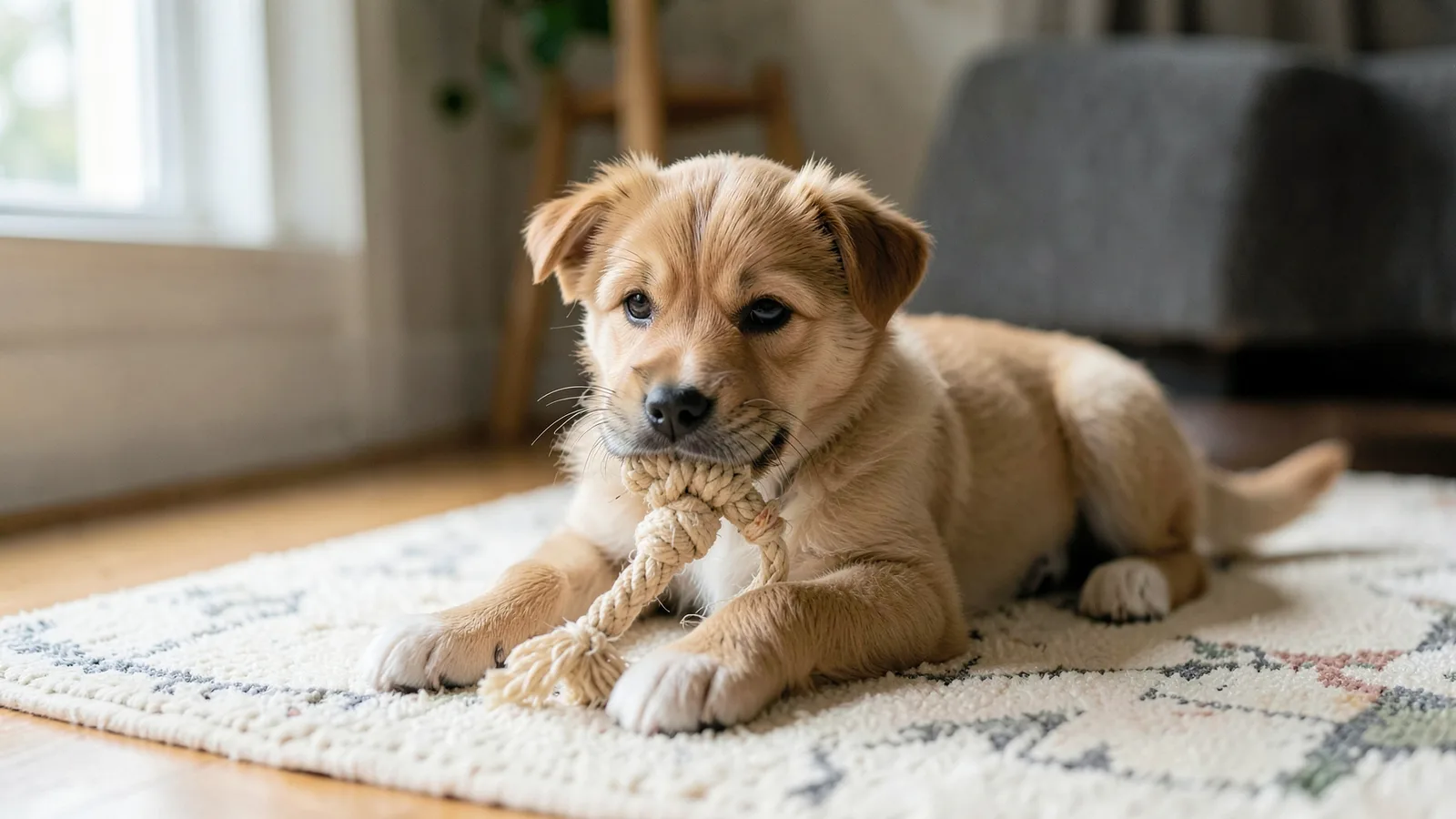
Your puppy still needs to bite something. Always have a toy within reach. When teeth touch you, pause, then offer a rope, a rubber chew or a soft toy. When your puppy takes it, praise calmly.
Tug games can help, too. They give a mouthy puppy a legal outlet. Keep the rules clear: the game stops if teeth land on your hand.
Method 4: Short, calm time-outs
If your puppy keeps lunging after your pause, use a brief time-out. Calmly place your puppy in a pen or crate with a chew toy for a minute or two. Keep your tone flat. This isn't punishment. It's a reset, like sending an overexcited kid to cool off.
Don't use the crate as a threat. It should stay a safe, happy place.
Method 5: Reward the quiet moments
Most owners only pay attention when a puppy bites. Flip that. When your puppy lies calmly next to you, or licks instead of nips, drop a treat or give gentle praise. You're teaching your puppy what earns your attention.
Why overtired puppies bite more
Here's the part many owners miss. A tired puppy doesn't act sleepy. It acts drunk. It gets hyper, mouthy and silly, much like a toddler who skipped a nap.
Young puppies need a lot of sleep, often most of the day. If your puppy gets snappy in the evening, check the clock. When did it last nap? Put it in its pen with a chew toy. Often it's asleep within minutes.
The witching hour is real
Many puppies have a wild burst of energy and biting in the early evening. It's usually a sign of overtiredness, not a bad puppy. A planned nap, a quiet chew and a short walk can stop it before it starts.
Exercise and brain games help too
A puppy with spare energy finds ways to burn it. Short walks, a sniffy game, a puzzle feeder or a snuffle mat all help. Aim for variety rather than long runs, since young puppies tire quickly and shouldn't be over-exercised.
A sample day of bite training
Knowing the methods is one thing. Fitting them into real life is another. Here's what a steady routine can look like for a puppy around 10 weeks old.
- Morning: Short potty break, breakfast from a puzzle feeder or scattered on a mat, then 10 minutes of gentle play with a toy. Stop before your puppy gets wild.
- Late morning: Nap in the pen. Expect one to two hours of sleep.
- Midday: Another short play session, with a quick pause-and-redirect each time teeth touch skin.
- Afternoon: Nap again, then a calm walk or sniff around the yard.
- Early evening: The witching hour. Offer a frozen chew in the pen before things escalate.
- Night: A last potty break, a quiet cuddle and bed.
Notice how many naps appear. Most owners under-schedule sleep and over-schedule play. A puppy that's well rested has far more self-control, the same way you're easier to live with after a good night's sleep.
Common mistakes that slow progress
Even careful owners fall into a few traps. Check whether any of these sound familiar.
Being inconsistent
If your puppy gets a game after biting on Monday and a time-out on Tuesday, it learns that biting sometimes works. That's the same pattern that keeps people pulling a slot machine lever. Pick one response and stick with it for at least two weeks.
Giving big reactions
Squealing, flapping and shouting are exciting to a puppy. Calm and boring wins. If a yelp gets a bigger reaction than a quiet pause, go quiet.
Skipping the toy
Stopping the game without offering something to chew leaves your puppy with an urge and no outlet. Always pair the pause with a toy, so your puppy learns what it should bite.
Waiting too long
The pause needs to happen at the moment of the bite, not ten seconds later. Puppies live in the moment. A late correction just looks like random behavior.
What not to do
Some old advice does harm. Please avoid these.
- Hitting, flicking the nose or scruffing. The ASPCA says physical punishment can backfire and cause fear and aggressive behavior. A puppy that's scared of your hands may bite harder, not softer.
- Holding the mouth shut. It frightens puppies and teaches nothing.
- Roughhousing with your hands. If you wrestle with fingers, you're teaching your puppy that hands are toys.
- Letting some people allow biting. Everyone in the home needs the same rules. Mixed messages slow everything down.
- Yelling. Noise and attention can reward the behavior.
Make the house easier
Training works faster when you manage the setup too.
- Keep toys in every room so you can redirect fast.
- Use a pen or baby gate to give your puppy a quiet space.
- Pick up trouble items such as shoes and cords.
- Wear clothes that don't dangle, or put on a long-sleeved top during play.
- Book a puppy class. Playing with other puppies teaches bite control, and a good class teaches you too.
When biting might be more than play
Most nipping is normal. But some biting needs a different approach. Play biting looks loose and bouncy. Dangerous biting looks stiff.
Watch for these:
- A frozen, tense body before the bite
- Growling over food, toys or a sleeping spot
- Biting when you handle paws, collar or mouth
- Biting that comes from fear, such as cowering first
- Snapping at you with no play invitation
If you see these signs, don't try to fix it with pause-and-redirect alone. The ASPCA advises seeing a vet first to rule out pain or illness, then a qualified trainer or behaviorist. Pain can turn a gentle dog snappy overnight. If your puppy also seems to be swallowing odd things, read our guide on pica in dogs.
What about a puppy that bites aggressively?
Puppies can look scary when they growl and lunge during play. Often it's just noisy play. Still, if your puppy goes stiff, stares or bites out of the blue, get help early. Early, calm intervention is much easier than fixing a habit in a grown dog.
When to get a trainer or behaviorist
The AKC suggests consulting an experienced trainer or animal behavior specialist if you haven't been able to moderate the biting by 6 months. Get help sooner if any of these apply:
- Your puppy has broken skin more than once and it's not improving
- Anyone in the house, especially a child, is afraid of the puppy
- The biting happens when your puppy is guarding something
- You feel your puppy is getting worse despite two to three weeks of consistent work
- Your puppy bites out of fear or when handled
Look for a trainer who uses reward-based methods. The ASPCA warns that trainers who suggest alpha rolls, scruff shakes or fear tactics can make a dog worse. For serious cases, a veterinary behaviorist can check for medical causes and, if needed, discuss medication alongside training.
For more on puppy training and behavior problems generally, see our puppy and behavior guides.
Be patient with the process. Most puppies improve steadily over a few weeks, with the occasional bad day. Stick to the plan, keep naps regular and keep your hands out of the game. In a few months you'll have a dog with a soft mouth and a lot less to worry about.
Common questions
Is it normal for a puppy to bite this much?
Yes. Puppies explore with their mouths, and play biting is a normal way of socializing. A puppy that mouths your hands, feet and sleeves all day is behaving like a puppy. The job is to teach it to be gentle, and that takes weeks of consistent practice.
Should I yelp when my puppy bites?
It works for many puppies because it mimics how a littermate reacts to a hard bite. But some puppies get more excited by the noise. If yours does, skip the sound, go quiet, pull your hand away and pause the game instead.
Can I hold my puppy's mouth shut or tap its nose?
No. Physical corrections like these can frighten a puppy and make biting worse. They can also teach a puppy that hands are scary, which is how some dogs end up reacting aggressively. Redirecting to a toy and ending the game works better.
When will my puppy stop biting?
Most puppies ease off as their adult teeth come in, usually by around 6 months, but only if they've been taught. If hard biting hasn't improved by then, a trainer or animal behavior specialist can help.
Sources
- How to Stop Puppy Biting and Train Bite Inhibition, American Kennel Club
- Mouthing, Nipping and Biting in Puppies, ASPCA
- Play Biting in Puppies, VCA Animal Hospitals
- Dog Aggression, ASPCA
This article is general information to help you decide what to do next. It is not a diagnosis and is not a substitute for examination by a veterinarian. If you are worried about your dog, call your vet.
Reviewed by Winzah, Editor, on . How we research and check articles.